
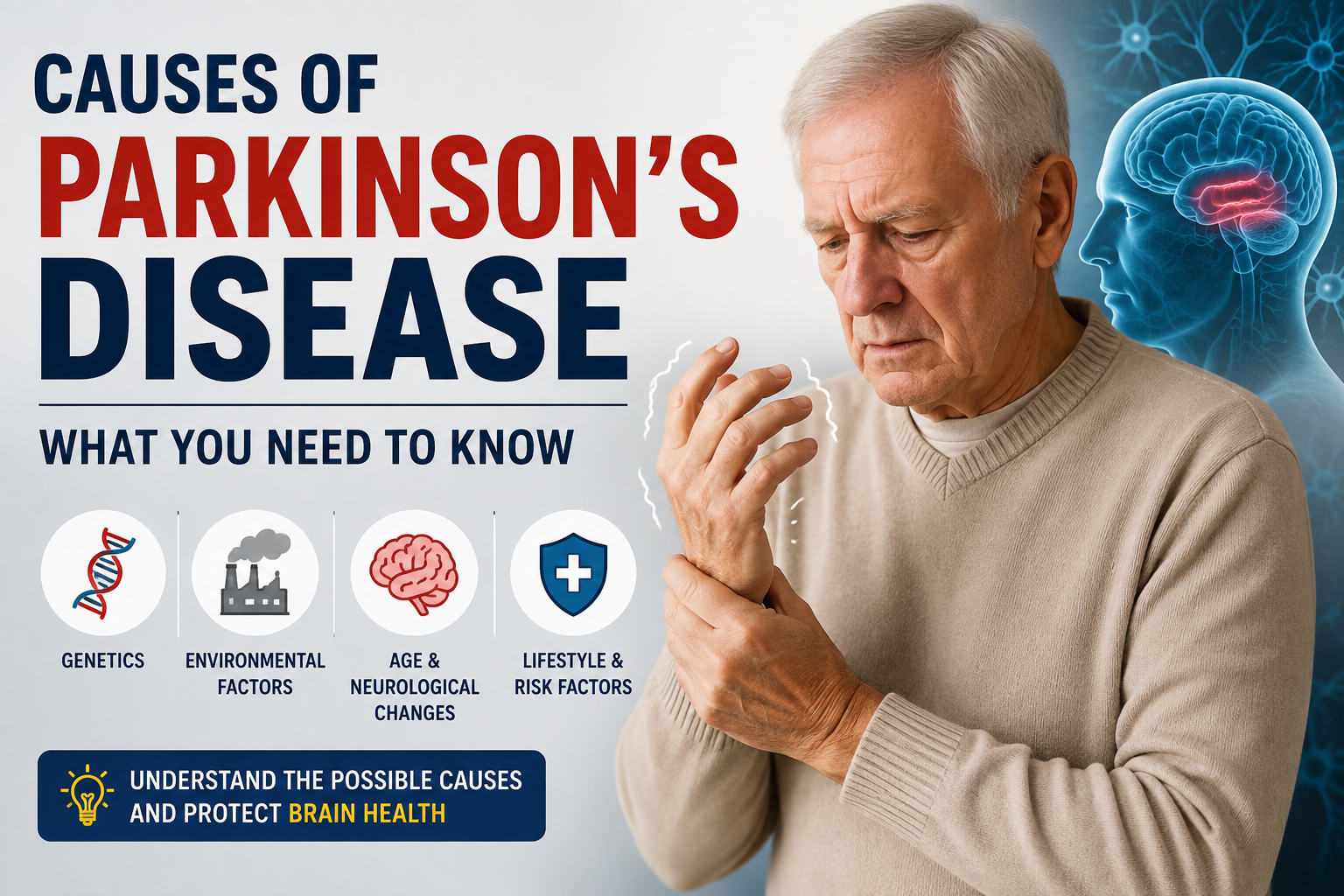
When people hear a diagnosis of Parkinson’s disease, one of the first questions they often ask is, “What causes Parkinson’s disease?” Understanding the causes of Parkinson’s disease can help people learn more about the condition, recognize possible risk factors, and have more informed conversations with their healthcare providers.
Parkinson’s disease can affect movement, sleep, mood, balance, and other areas of daily life. It may start with symptoms that seem minor, such as a slight tremor, stiffness, slower movement, or changes in walking.
The exact cause is not yet known. Researchers believe Parkinson’s develops through a combination of genetic, biological, environmental, and age-related factors rather than one single cause.
Medical disclaimer: This article is for educational purposes only and is not medical advice. Parkinson’s disease requires professional evaluation and treatment. Do not stop, reduce, or replace prescribed Parkinson’s medication because of information in this article or any natural-health program.
What Is Parkinson’s Disease?
Parkinson’s disease is a progressive disorder of the nervous system that mainly affects movement. It develops when certain nerve cells in the brain become damaged or die.
A major part of the condition involves nerve cells in an area of the brain called the substantia nigra. These cells produce dopamine, a chemical messenger that helps the brain control smooth and purposeful movement.
As dopamine-producing cells are lost, movement-related symptoms can develop. These may include tremors, stiffness, slowed movement, balance difficulties, changes in walking, and speech changes.
Parkinson’s can also involve non-movement symptoms, including constipation, sleep problems, changes in the sense of smell, fatigue, anxiety, depression, and thinking or memory difficulties.
What Are the Causes of Parkinson’s Disease?
There is currently no single known cause of Parkinson’s disease.
Scientists believe the condition probably develops because several factors interact with one another. These may include:
- Aging
- Genetic differences
- Family history
- Environmental exposures
- Changes inside brain cells
- Loss of dopamine-producing neurons
- Oxidative stress
- Mitochondrial problems
- Other biological processes
Having one of these risk factors does not mean that a person will definitely develop Parkinson’s disease. Likewise, many people diagnosed with Parkinson’s have no obvious family history or clearly identifiable environmental cause.
1. Age as a Risk Factor
Age is one of the strongest known risk factors for Parkinson’s disease.
The condition becomes much more common as people get older. Parkinson’s can also occur in younger adults, but younger-onset cases are less common.
Getting older does not mean someone will automatically develop Parkinson’s. Researchers believe that changes associated with aging may make certain brain cells more vulnerable to damage.
2. Genetics and Family History
Genetics can also play a role in the causes of Parkinson’s disease.
Researchers have identified several genetic variations associated with Parkinson’s. Some rare genetic mutations can contribute directly to inherited forms of Parkinson’s, while other genetic variations may increase susceptibility without guaranteeing that the disease will develop.
Having a close relative with Parkinson’s may increase a person’s risk, but it does not mean that they will definitely develop the condition.
If several close family members have Parkinson’s, discussing your family history with a doctor or genetic counselor may be helpful.
3. Environmental Exposures
Environmental factors are another area researchers are studying when looking at the causes of Parkinson’s disease.
Some studies have found associations between Parkinson’s risk and exposure to certain pesticides, herbicides, and other toxins.
However, exposure to one of these substances does not automatically mean that a person will develop Parkinson’s. The relationship is complicated, and scientists continue to investigate how environmental exposures may interact with genetics and other biological factors.
People who work around pesticides, industrial chemicals, or other potentially hazardous substances should follow appropriate workplace safety procedures.
4. Changes in Brain Cells
Changes inside brain cells are an important part of Parkinson’s research.
One well-known finding is the presence of Lewy bodies, which are abnormal protein-containing structures found inside nerve cells.
A protein called alpha-synuclein is an important component of Lewy bodies. Researchers are studying how abnormal accumulation or clumping of this protein might contribute to nerve-cell damage.
Scientists are also investigating mitochondrial dysfunction, oxidative stress, inflammation, and other cellular processes.
These discoveries may eventually help researchers develop better ways to diagnose and treat Parkinson’s disease.
5. Dopamine Loss
Dopamine loss is central to understanding Parkinson’s disease, although dopamine loss itself is not considered the original cause.
Dopamine is a chemical messenger that helps the brain coordinate smooth and purposeful movement.
When dopamine-producing neurons in the substantia nigra become damaged or are lost, the brain has more difficulty controlling movement.
This helps explain why symptoms such as tremors, stiffness, and slowed movement can occur.
Researchers continue to investigate why these particular neurons become vulnerable in the first place.
6. Oxidative Stress and Cellular Damage
Oxidative stress is another area researchers are studying when investigating the causes of Parkinson’s disease.
Cells naturally produce molecules that can cause damage when they become excessive. Normally, the body has systems that help control these molecules. When the balance is disrupted, cellular damage can occur.
Scientists are studying whether oxidative stress contributes to the degeneration of dopamine-producing neurons.
Certain genetic changes may also affect how cells deal with cellular stress and energy production.
However, it is important not to assume that taking a particular antioxidant or supplement can prevent or cure Parkinson’s disease. More research is needed.
7. Mitochondrial Problems
Mitochondria are often described as the energy-producing parts of cells.
Brain cells require a large amount of energy to function properly. Researchers have found mitochondrial changes in the brains of people with Parkinson’s and are investigating whether impaired cellular energy production contributes to nerve-cell damage.
This remains an active area of research and does not currently translate into one simple dietary or supplement solution for Parkinson’s disease.
8. Gut Health and the Gut-Brain Connection
The relationship between the digestive system and the brain has become another interesting area of Parkinson’s research.
Some research suggests that changes involving the gut, gut bacteria, and other biological processes may be associated with Parkinson’s disease.
However, the science is still developing.
It would be misleading to say that poor gut health has been proven to cause Parkinson’s or that changing gut bacteria can cure the disease.
Instead, the gut-brain connection remains an area that researchers are continuing to investigate.
9. Sleep and Other Health Factors
Sleep is another area of interest when researchers study Parkinson’s disease.
Some people with Parkinson’s experience sleep problems, and certain sleep disorders can occur before or alongside other symptoms.
Researchers are continuing to investigate how sleep, brain health, and other biological processes may be connected.
Good sleep is valuable for overall health, but it should not be confused with a proven treatment or cure for Parkinson’s disease.
Can Knowing the Causes of Parkinson’s Disease Help With Prevention?
Unfortunately, knowing the possible causes of Parkinson’s disease does not currently provide a guaranteed way to prevent the condition.
Because researchers have not identified one definitive cause, prevention remains difficult.
Some research has linked regular aerobic exercise and caffeine consumption with a lower risk of developing Parkinson’s, but these findings do not mean that exercise or caffeine can guarantee prevention.
A healthy lifestyle can still be worthwhile because it supports overall physical and mental health.
Regular physical activity, nutritious food, adequate sleep, social connection, and appropriate medical care can all be important parts of living well.
Can Lifestyle Changes Help Someone With Parkinson’s?
Lifestyle changes are not a cure for Parkinson’s disease, but they may be an important part of overall management.
Exercise, nutrition, sleep, and other healthy habits can support general health and quality of life.
Exercise and Parkinson’s Disease
Depending on a person’s abilities and medical situation, activities such as walking, strength exercises, balance work, stretching, or other forms of physical activity may be included in a Parkinson’s care plan.
The appropriate type and intensity of exercise should be discussed with a healthcare professional or physical therapist.
Nutrition and Parkinson’s Disease
A balanced diet can help support energy, digestive health, heart health, and general wellbeing.
However, people with Parkinson’s should be cautious about websites or programs that promise to reverse the disease, cure Parkinson’s, or replace prescribed treatment.
What Is The Parkinson’s Disease Protocol?
If you are researching lifestyle approaches for Parkinson’s disease, you may come across The Parkinson’s Disease Protocol, a digital program offered by Blue Heron Health News.
The program is marketed as a lifestyle-focused approach for people interested in additional strategies related to Parkinson’s. It discusses areas such as nutrition, movement, daily habits, and other lifestyle considerations.
It is important to understand what this type of product is and what it is not.
The Parkinson’s Disease Protocol is a digital information and lifestyle program, not a prescription medication or an established cure for Parkinson’s disease.
If you want to learn more about the program, you can visit the official offer page:
The program may be interesting to people who want to learn about lifestyle strategies, but anyone with Parkinson’s should discuss changes to diet, exercise, supplements, or medication with their healthcare professional.
Is The Parkinson’s Disease Protocol a Replacement for Parkinson’s Treatment?
No.
People with Parkinson’s should not stop taking prescribed medication or discontinue medical treatment because they are following an online lifestyle program.
Medical treatment can include medications and, for some people, procedures such as deep brain stimulation. Treatment is individualized according to symptoms, disease stage, overall health, and other factors.
A lifestyle program should therefore be viewed, if appropriate, as a source of complementary lifestyle information rather than a substitute for professional Parkinson’s care.
When Should You Talk to a Doctor?
Understanding the causes of Parkinson’s disease is useful, but recognizing possible symptoms is equally important.
Talk with a healthcare professional if you or someone you know develops symptoms that could be related to Parkinson’s, including:
- Tremor that occurs when a limb is at rest
- Slower movements
- Muscle stiffness
- Changes in walking
- Balance problems
- Smaller or more cramped handwriting
- Changes in speech
- Reduced facial expression
- Loss of sense of smell
- Sleep problems
- Constipation
- Unusual fatigue
These symptoms do not automatically mean someone has Parkinson’s disease. Other conditions can produce similar symptoms, which is why proper medical evaluation is important.
Final Thoughts on the Causes of Parkinson’s Disease
The causes of Parkinson’s disease are complex and are still being studied.
Age, genetics, environmental exposures, changes in brain cells, dopamine loss, oxidative stress, mitochondrial dysfunction, and other biological processes may all play a role. However, researchers have not identified one single cause that explains every case.
For someone already living with Parkinson’s, learning about exercise, nutrition, sleep, daily habits, and other lifestyle factors may be useful as part of an overall care plan.
The Parkinson’s Disease Protocol may be worth researching if you are interested in a digital lifestyle program focused on Parkinson’s-related habits and strategies. However, it should not be considered a replacement for professional medical care or prescribed treatment.
If you’re researching lifestyle approaches for Parkinson’s disease, you may also want to read our The Parkinson’s Protocol Review 2026
If you decide to explore the program, read the information carefully, consider whether its recommendations are appropriate for your situation, and speak with your healthcare professional before making significant changes.
Affiliate Disclosure
This article contains an affiliate link. If you purchase The Parkinson’s Disease Protocol through our link, we may receive a commission at no additional cost to you. This does not change the information presented above or guarantee any particular result.
Pingback: The Parkinson's Protocol Review 2026: Does It Work